Made-to-measure wooden walk-in wardrobes in Gandia
Talking about made-to-measure wooden walk-in wardrobes in Gandia means talking about materials: how much of the wardrobe will be real wood, which parts can be a decorative board, and how much of it will actually be on show. This page helps you decide with confidence. We go through the difference between solid wood, natural veneer and wood effect, how to choose the tone and grain, what to expect when it comes to cleaning, and how each material affects the quote before you request your proposal.
Shape your next wardrobe.
Try out the measurements, plan the interior layout and choose your finishes. See your idea take shape and share it with us so we can prepare your quote.
Send us your configuration with your measurements and we'll give you a guide price within 24 hours, free of charge. The measuring visit at your home comes afterwards.
Deciding where you want visible wood
Before talking about species or prices, it helps to ask where the wood will actually be seen. In a wooden walk-in wardrobe there are areas you look at every day, such as the drawer fronts, the side uprights or the central panel, and others you hardly ever see, such as the backs, the sides hidden behind another unit, or the rear panels.
Spending on premium material where nobody looks is one of the most common ways a budget gets out of hand. The sensible approach is to concentrate quality on what is visible and deal with the rest using a simpler, hard-wearing material.
A good way to start is to sketch the room and mark in one colour the surfaces that will come into your line of sight as you walk through the door. Those are the candidates for the main material, and you can send the sketch along with your measurements from the configurator.
Solid wood, natural veneer and decorative board
These are three different materials and shouldn't be confused. Solid wood is the whole piece, with its grain and weight, and it reacts to humidity: it moves, and needs a joint design that allows for that. Natural veneer is a thin sheet of real wood bonded onto a stable board; it shows off the genuine grain with less risk of warping.
Decorative board, which imitates the look of wood with a printed or textured layer, costs less and stands up well to scuffs, although its pattern repeats and it isn't natural wood. It's worth saying this plainly, because the resemblance can be very good from a distance and quite different up close.
Which one suits you depends on what you touch and how often, and on how much importance you give to authenticity. The exact availability of each option is confirmed when we review your project.
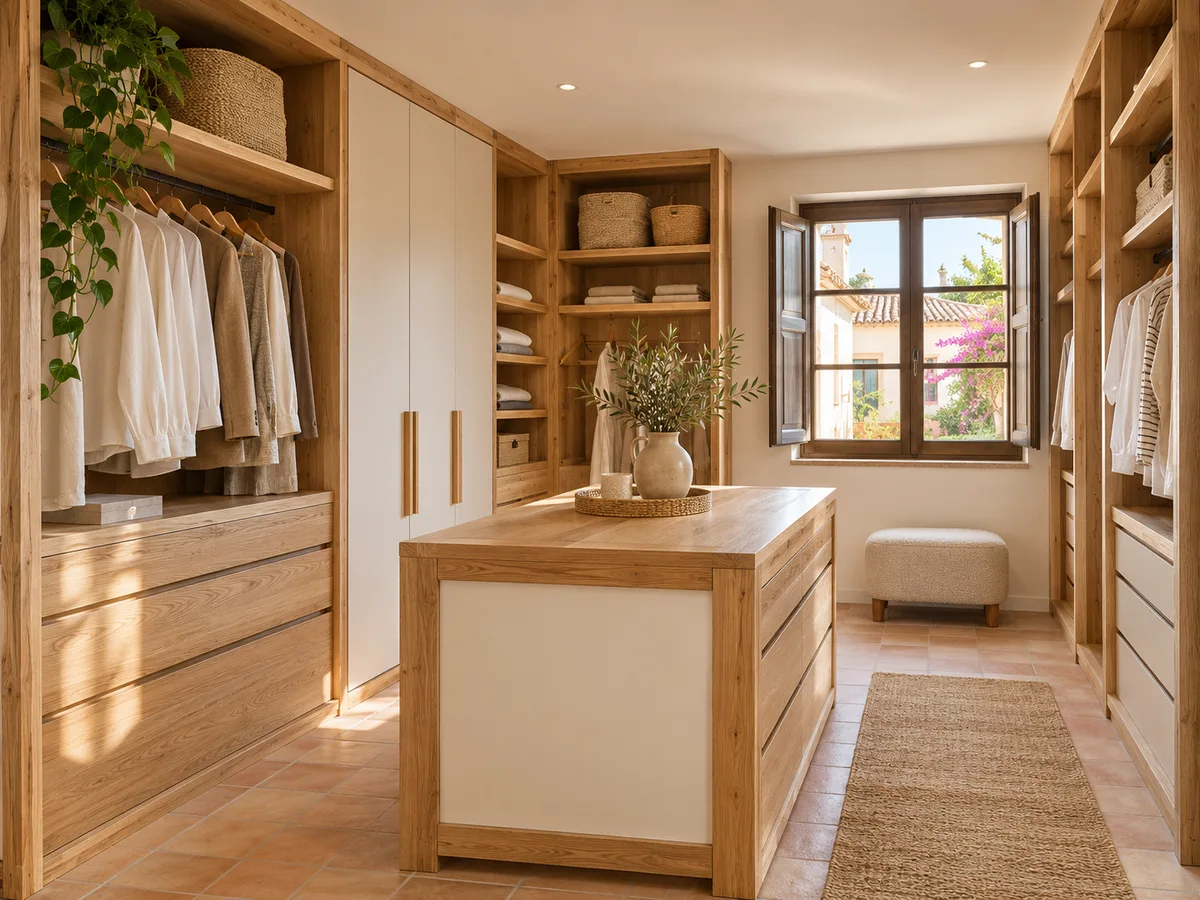
Structure, doors and accessories
A walk-in wardrobe is made up of parts with different jobs, and they don't have to share the same material. The structure, meaning the sides, shelves and dividers, carries weight and has to be stable. The drawer and door fronts are what you see and touch. Accessories such as rails, hooks, trays or dividers work for function rather than looks.
Two conditions guide the choice. The first is load: a long shelf with folded clothes needs a board with a good edge and, if the span is wide, an intermediate support. The second is contact: drawer fronts take more wear than a side panel and benefit from a finish that holds up.
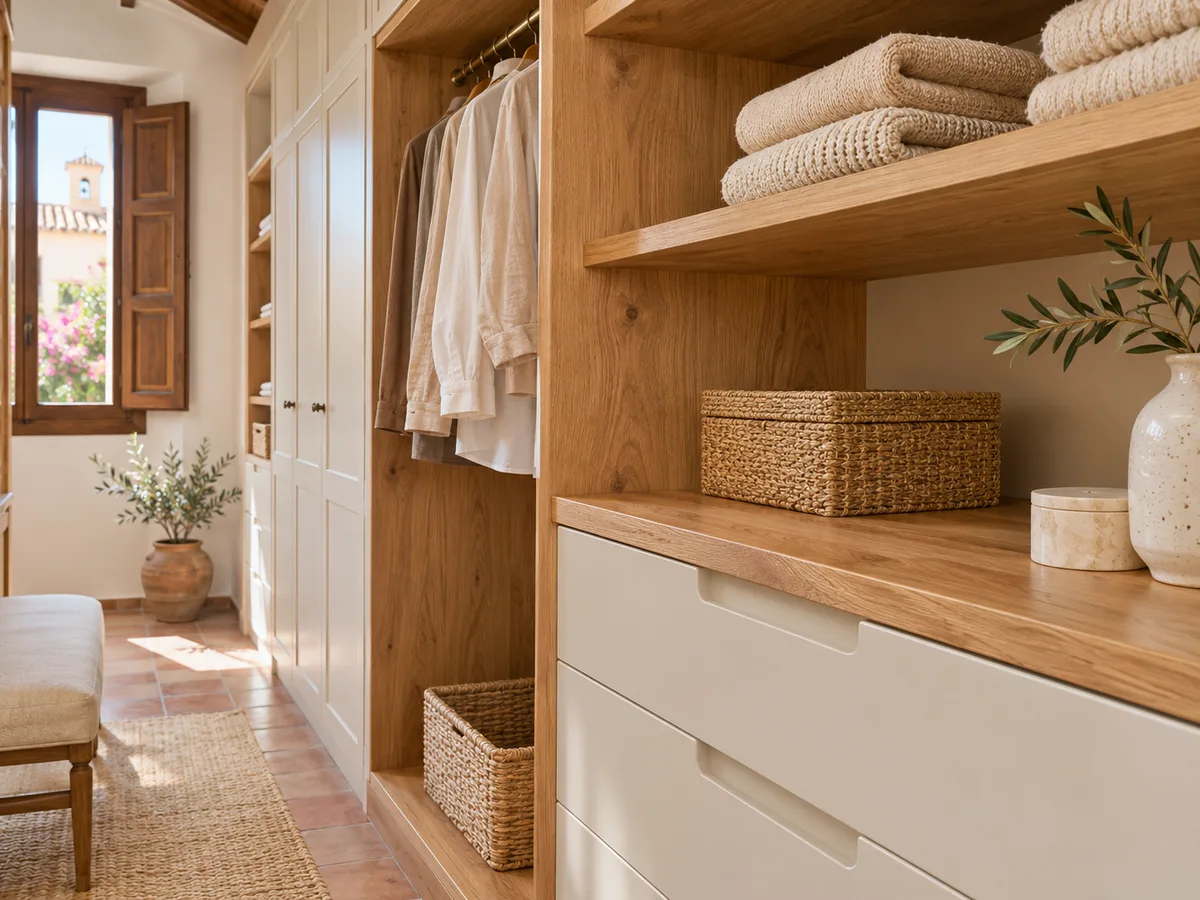
A common approach is to use natural veneer or solid wood on the visible elements and a restrained decorative board inside. You get a well-presented wooden walk-in wardrobe without inflating the cost.
Have you already measured the space?
Send us a photo and the approximate measurements on WhatsApp and we'll give you some initial guidance.
Tone, grain and physical sample
- 01
The colour of a wood changes with the light, the walls and the floor. What looks honey-coloured in a photo can look orange in the late afternoon in a Gandia bedroom with a west-facing window, and grey under cool LED light.
- 02
That is why the physical sample is the main tool. It is placed next to the wall, near the floor and the interior doors of your home, and viewed at different times of day. This is how you settle the tone and also the finish: matt, satin or open-pore, which lets you feel the grain by touch.
- 03
The grain deserves its own step. A bold, long grain gives movement; a more discreet one blends in easily. With natural veneer every piece has its own nuances, so it's worth discussing how they are laid out across neighbouring units so that they read as one whole.
Latest work by SI, ARMARIO
@si.armario
Made-to-measure wardrobes and walk-in wardrobes
Latest posts
Combining wood with other surfaces
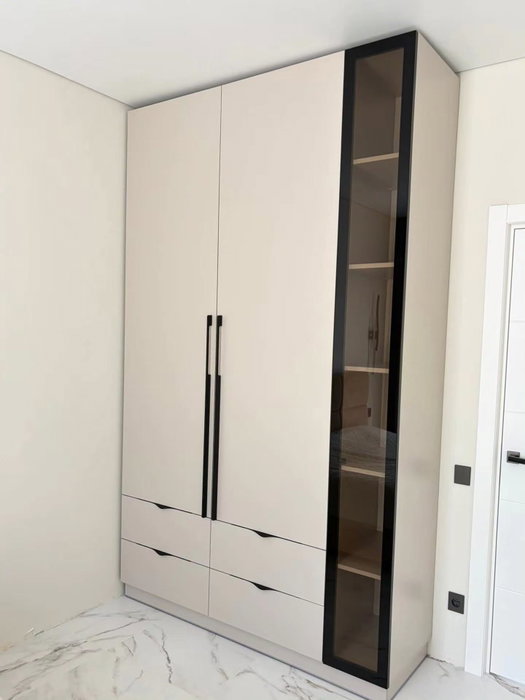
A walk-in wardrobe is rarely made of a single material. Wood sits well alongside smooth, matt surfaces, slim metal handles and rails, a neutral-coloured board at the back, and a mirror on a door or panel.
The key is balance. If wood covers every wall, the room can feel heavy; if it is limited to one unit, one front or a finishing shelf, it becomes an accent that adds warmth.
There are simple combinations that work: wood on the drawers with a light back panel; wood on the vertical uprights with white shelves; dark wood on a central unit with neutral tones around it. Each one changes the character of a wooden walk-in wardrobe without changing its capacity.
To choose between styles with more personality, you can see how a modern or a rustic walk-in wardrobe is approached in the solutions section of the website.
Cleaning and performance by finish
Each finish behaves differently in daily use. Varnished solid wood resists scuffs well and can be cleaned with a damp cloth, and it can also be sanded and refreshed; with an oil finish the feel of the wood comes through more, but it needs a little more care.
Natural veneer with varnish protects the grain and is easy to clean as long as you avoid harsh products. Decorative board usually holds up well to marks and light humidity, although a hard knock on the edge is harder to repair.
In a coastal area like Gandia, ambient humidity affects solid wood more than a stable board. This is taken into account when designing the joints, and we avoid placing long solid-wood pieces against a cold wall or one with condensation.
For any of them, neutral cleaning products and soft cloths are enough, and prolonged direct sunlight can lighten the tone of the most exposed areas over the years.
Ask us to come and measure up in Gandia
- 01You leave us your name and your area.
- 02We message you on WhatsApp to agree a day.
- 03The measuring visit costs €50 and is free if you place an order.
How the material affects the quote in Gandia
Material is one of the factors that moves the final figure the most. Solid wood is usually the most expensive option, natural veneer sits somewhere in the middle, and decorative board is the most economical. But the price doesn't depend on that alone.
The amount of visible surface, the complexity of the edges and drawers, the number of curved pieces and the labour needed to match the grain between units all count too. A simpler walk-in wardrobe with premium wood on the fronts can cost less than a complex one in decorative board.
It's a good idea to ask for a guide price with several combinations and compare them. Once we have received your configuration with measurements, the team gives you a price guide, and the prices page explains what a quote includes and what can change it.
The measuring visit costs €50 if the project isn't commissioned, and manufacturing takes around 2–3 weeks on average.
Choosing between a modern and a rustic style
- 01
Wood doesn't dictate the style, but it does influence it. A light wood with a fine grain and flat fronts points towards contemporary; a bolder one, with a warm tone and visible pores, brings a more country feel.
- 02
If you're unsure, ask yourself three questions. What is the character of the bedroom where the walk-in wardrobe will go? What wooden furniture do you already have, and how much do you like its tone? Do you want the walk-in wardrobe to go unnoticed or to be the star of the room?
- 03
With your answers, the made-to-measure wooden walk-in wardrobe can be fine-tuned: you choose the species or finish, decide whether it will have handles or a discreet opening, and set the level of texture. What matters is that the result feels consistent with the rest of your home.
Enquiry
Tell us about your project in Gandia
- 1We read your message and look at your photos.
- 2We reply on WhatsApp with a first figure.
- 3We measure up and prepare the final quote. The measuring visit costs €50 if you don't go ahead with the order and is free if you do.
We don't cut a single board until you've approved the design and the price.
Questions
Frequently asked questions about wardrobes in Gandia
After installation: warranty and care for your wardrobe.
Which parts of a walk-in wardrobe are worth doing in natural wood?
Almost any: fronts, uprights, shelves or panels. The usual approach is to keep natural wood, whether solid or veneer, for what you see and touch, and use a stable board for the backs and hidden structure.
How can I tell natural veneer from wood effect?
By looking closely. Veneer has a real grain, with small variations between pieces, while wood effect repeats the same pattern. On the physical sample, the feel and the repetition of the pattern help you tell them apart.
Do I need to use the same material throughout the walk-in wardrobe?
No. Combining wood on the visible parts with another material inside is the most common and sensible choice. The tones just need to sit well together, which you can check by comparing the samples side by side.
How are the tone and finish agreed before manufacturing?
With a physical sample placed in your room and a plan showing which material goes on each surface. If something doesn't convince you, it is adjusted before manufacturing.
Is solid wood always the best option?
Not necessarily. It has presence and can be refreshed, but it reacts to humidity and adds to the cost. In many rooms, natural veneer gives a very similar look with more stability.
Shall we talk about your project?
Send us a photo of the space and some approximate measurements on WhatsApp: we'll give you some initial guidance and arrange the measuring visit.