Made-to-measure corner wardrobes in Gandia
The corner of a room is often left empty because almost no off-the-shelf furniture knows how to make use of it. Made-to-measure corner wardrobes in Gandia solve exactly that meeting point between two walls: they are designed as an L-shape or as modules that sit against one another, and they can turn an awkward corner into your best storage area. We explain how a corner is organised, how you reach the back, and which door options work best.
Shape your next wardrobe.
Try out the measurements, plan the interior layout and choose your finishes. See your idea take shape and share it with us so we can prepare your quote.
Send us your configuration with your measurements and we'll give you a guide price within 24 hours, free of charge. The measuring visit at your home comes afterwards.
Why a corner is so hard to use well in Gandia
Where two walls meet, the depth of one wardrobe runs into that of its neighbour, creating a space that is hard to reach. If you fit a straight front, that corner is either wasted or filled with things that never come out.
A corner wardrobe treats that area as a piece in its own right. It can be a diagonal module, an L-shaped unit with both wings joined, or two wardrobes that meet and share a stretch of front. Each solution changes how much usable space is left inside and how easily you can reach the back, which is the real challenge with this type of furniture.
L-shaped wardrobe or two modules that meet
The L-shaped corner wardrobe is a single unit that turns the corner. Its advantage is continuity: the inside connects both wings and the structure is very stable. It works well in rooms with fairly straight walls.
The alternative is two separate modules that meet at the corner. They are easier to transport and to adjust if the walls are not square, which is common in older homes in Gandia. The practical difference is in the corner itself: with the L you can leave a hanging-rail area that makes use of the full depth, whereas with two modules you usually leave a stretch of shelving or an access gap.
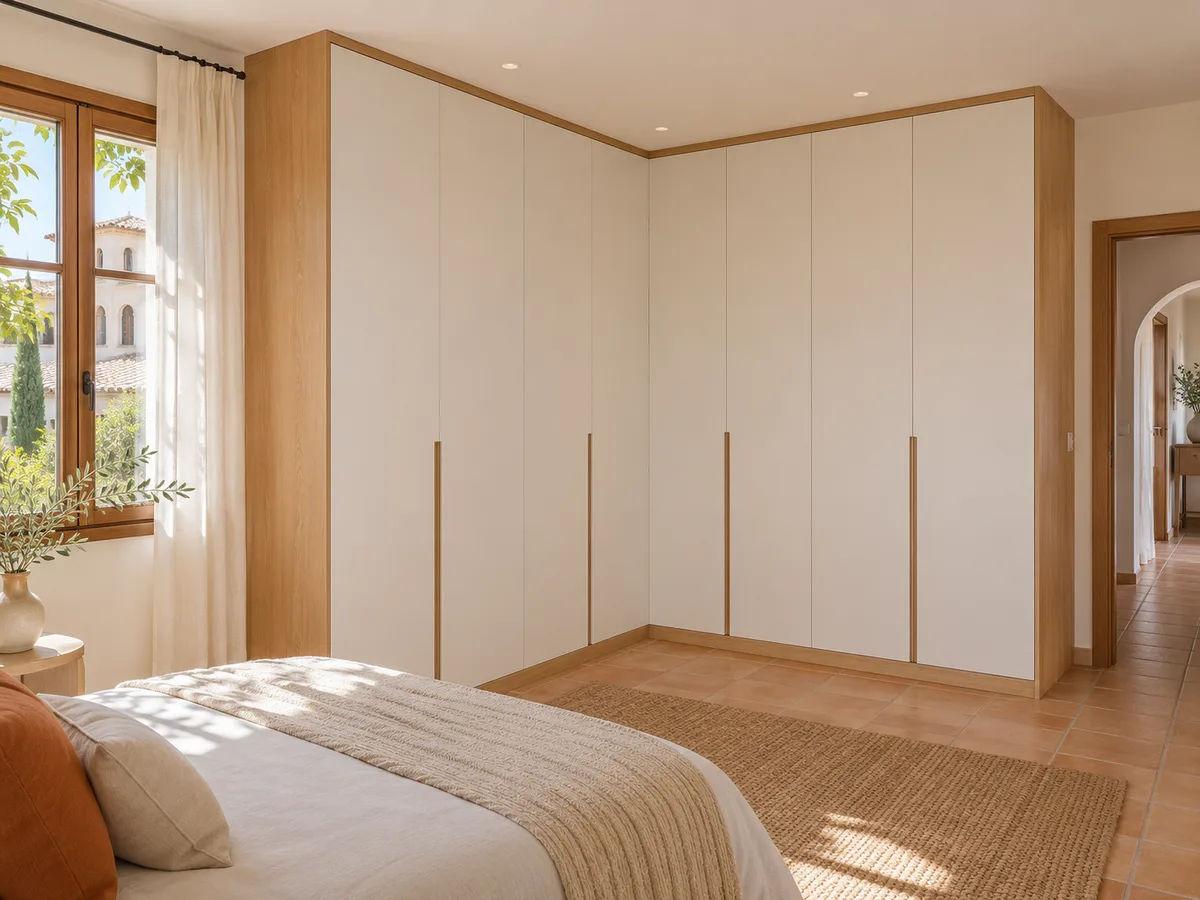
Organising the inside of the corner
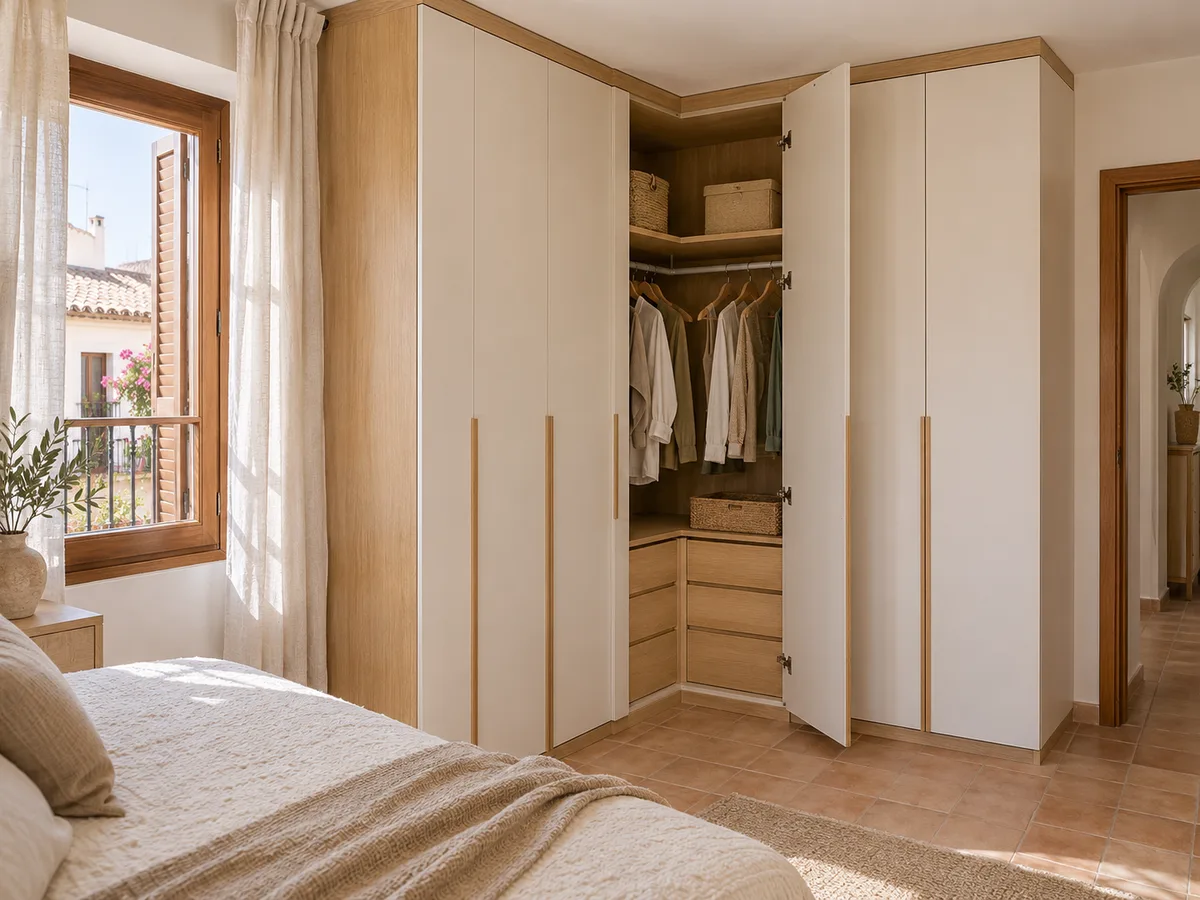
The back of a corner is deep, and what you store there is hard to see. The best idea is to keep that area for things you rarely use: suitcases, out-of-season clothes, duvet boxes or large bags.
The hanging rails go at the front, so that everyday clothes are within easy reach. A good layout puts the deepest shelves in the corner and the drawer sections in the wings, where they can be pulled out without getting in the way. If the wardrobe is tall, the top cupboards in the corner are ideal for occasional-use items.
Have you already measured the space?
Send us a photo and the approximate measurements on WhatsApp and we'll give you some initial guidance.
Reaching the back of the corner
- 01
There are several ways to reach what is left in the corner. Rotating shelves, a classic of the corner wardrobe, let you turn the contents and bring them towards you; pull-out rails bring the hangers out of the corner; and corner doors open up the whole space at once.
- 02
A simpler option is to leave a stretch of front with a hinged door in the corner, so the corner is left clear and you can step inside. Not every solution suits every wardrobe: it depends on the depth, the type of clothes and how you use it, and is settled in the design. What matters is that the person using the wardrobe can reach the back without emptying the front every time.
Sliding and hinged doors in the corner
Combining sliding and hinged doors in the same corner wardrobe is a very common solution. The hinged doors go in the corner, where they give full access, and the sliding doors take the straight runs, where they save space.
The point where the two systems meet is carefully worked out so that the doors don't clash and the gaps are even. If there is a room door or a window nearby, the swing arc is calculated so the door doesn't block it. A well-designed combination gets the best from each type of opening without giving up a clean line across the front. In Gandia, where many rooms are modest in size, this mix is often the most practical.
Corners with a door, window or radiator
Many corners are not an empty nook: there may be a door right beside it, a window starting close by, or a radiator underneath. The corner wardrobe adapts by working around these features with a stepped piece, a narrow gap, or a front that doesn't cover the window.
With a room door next to the corner, it is sometimes best for the wardrobe not to reach the door frame, so the door can swing freely. With a radiator, we leave a perforated panel or a section without a back so the heat can circulate. Once you tell us what is around the corner, it is easier to propose the outline that fits best.
Latest work by SI, ARMARIO
@si.armario
Made-to-measure wardrobes and walk-in wardrobes
Latest posts
Ask us to come and measure up in Gandia
- 01You leave us your name and your area.
- 02We message you on WhatsApp to agree a day.
- 03The measuring visit costs €50 and is free if you place an order.
An L-shaped wardrobe and an L-shaped walk-in wardrobe are not the same thing
An L-shaped wardrobe fills the corner of a room and opens from the same space you use. An L-shaped walk-in wardrobe is a small room you step into, with the storage on the walls around you. The measurements, the type of access and the space lost all change.
If what you want is a piece of furniture against two walls, the corner wardrobe is the answer. If you need somewhere to get dressed comfortably and you have a spare room or a generous space, a walk-in wardrobe is worth considering. In both cases we start from the same measurements, and designing it in the configurator helps you decide.
Finishes and light in a corner
- 01
Light reaches a corner less well and the interiors can end up dark. A light finish inside and out helps compensate, and interior lighting in the deep areas makes it easier to see what is at the back.
- 02
Plain fronts without mouldings avoid shadows between the doors where the two wings meet. If the corner is very visible from the door, it can be finished with an exposed side panel in the same material, so the whole thing looks like a single piece of furniture rather than two units pushed against the wall. A mirror on the straight run also adds a sense of depth and bounces light back into the room.
How to request your corner wardrobe
Go to the configurator and mark the two walls that form the corner, with the width of each and the clear height. Once the design is ready and the measurements noted, the team will send you a guide price in about a day, at no cost.
The measuring visit is then booked: €50 if you end up not ordering the wardrobe, and free of charge if you do. Manufacturing takes two to three weeks on average, and the installation is arranged separately. If you would rather ask first, message us on WhatsApp or open the quote form with a photo of the corner and the measurements of each wall, from the corner to the nearest window or door.
Enquiry
Tell us about your project in Gandia
- 1We read your message and look at your photos.
- 2We reply on WhatsApp with a first figure.
- 3We measure up and prepare the final quote. The measuring visit costs €50 if you don't go ahead with the order and is free if you do.
We don't cut a single board until you've approved the design and the price.
Questions
Frequently asked questions about wardrobes in Gandia
After installation: warranty and care for your wardrobe.
Do I always gain space by putting the wardrobe in the corner?
Not always, but it almost always makes better use of the area. You gain when the corner is empty or wasted; if there is a door or window right next to it, we first work out how much usable depth is really left.
Where does the hanging clothing go inside a corner?
The rails are kept for the wings, and the corner is used for deep shelves, suitcases or out-of-season clothes. That way the things you use most are within easy reach and you don't have to move anything at the back.
Can I combine sliding and hinged doors in the corner?
Yes, and it is very common. The hinged doors go in the corner, where they give full access, and the sliding doors on the straight runs to save space. The design makes sure the doors don't clash where they meet.
L-shaped wardrobe or L-shaped walk-in wardrobe: which should I choose?
The L-shaped wardrobe is a piece of furniture that opens into the room; the L-shaped walk-in wardrobe is an area you step into to get dressed. The space needed and the way you reach your clothes both change.
Can a corner wardrobe be made if the walls are not square?
Yes. We measure up during the visit and the wardrobe is adjusted with edging strips or fillers. In homes with uneven walls this is routine and does not affect the final look.
What happens if there is a window near the corner?
We design an outline that respects it, with a lower section, a stepped side or a front that finishes earlier. Tell us the distance from the window to the corner and we will work out the best way to go around it in your room in Gandia.
Shall we talk about your project?
Send us a photo of the space and some approximate measurements on WhatsApp: we'll give you some initial guidance and arrange the measuring visit.